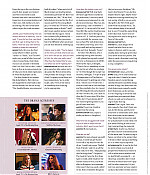
“I’m Not Settling for Lip Service”: Janelle Monae, Jennifer Aniston, Zendaya, Reese Witherspoon, Helena Bonham Carter, Rose Byrne and the Drama Actress Roundtable
Six top actresses get real about everything from dismantling systemic racism (“It can’t just be, ‘We’re going to march with you and do a hashtag'”) to fighting typecasting (“For the life of me, I could not escape ‘Rachel from “Friends”‘”).
he Hollywood Reporter’s Drama Actress Roundtable was set to take place two weeks before it actually did. But as the country hit a boil, erupting in protest following the killing of George Floyd, its early June timing no longer felt right.
The actresses — The Morning Show’s Jennifer Aniston and Reese Witherspoon (also of Little Fires Everywhere and Big Little Lies), Homecoming’s Janelle Monáe, Euphoria’s Zendaya, Mrs. America’s Rose Byrne and The Crown’s Helena Bonham Carter — collectively decided they needed the space and time to properly process what was happening around them. And with it, a chance to listen and learn.
When the sextet ultimately came to the (virtual) table on June 20, they spoke candidly about their own reckonings along with their professional fears and the power that they, as women, have now like never before. As Witherspoon says at one point, “We know that we matter.”
Zendaya, before Euphoria, I’ve heard you talk about the pressure, almost to the point of paralysis, that you felt about making your next move. What was that pressure, and how much of it was internal versus external?
ZENDAYA I think, like a lot of artists, I’m my biggest critic, so some of it was internal — not wanting to make a mistake or worrying that maybe I didn’t have the room to make a mistake and wanting to make the right next move. But I also wanted to prove myself. When Euphoria came along, I was very grateful because all those fears melted away and I felt like it was something that I had to be a part of. So, the fear became just, like, push yourself. If you go to work and you’re scared, that’s a good thing. You should be worried about whether you can do it.
MONÁE I just want to say you were brilliant.
WITHERSPOON I agree, and I’d be scared to play that character, too.
ZENDAYA I appreciate that so much.
You just said you didn’t feel you had the room to make a mistake. Can you elaborate on that idea and how it impacts your choices?
ZENDAYA It’s a constant thing. Being a young Disney actor, that’s one level, being a young Black woman is one level, and then being very hard on myself is another level. It’s also just a personal fear. I want to do a good job, and sometimes that can cause you to be fearful of things. But I will say that there’s something that happens when a special character comes along, for me at least, and those fears melt away. They don’t come back until it starts airing, which is when I started to get a little scared again. (Laughter.) But now, I’m excited to go back because the motivation is to work harder and become a better actress. I just want to get better.
Zendaya, you took to Instagram before Euphoria’s premiere to warn your fans, many of whom are young, about what they’d see. How much do you grapple with what your fan base can handle? And how does it impact your choices?
ZENDAYA I have a heavy responsibility on my shoulders, but I’m appreciative for that because with that there’s a lot of good that I can do and I know who is watching. Now, more than ever, specifically with Black Lives Matter and everything, I feel an obligation to make sure that I’m aware and putting out the right things and in line with organizers and people who are on the ground.
BYRNE Can I ask how old are you?
ZENDAYA I’m 23.
BYRNE That’s extraordinary. I mean, at 23, I was a depressive weirdo. (Laughter.) You are so composed and erudite.
ZENDAYA Thank you, I’m just figuring it out as I go, trying to do the best I can. And when it came to Euphoria, I just wanted to make sure that my fans knew, even the ones who were my age or older than me, that I still felt their support even if they felt that the material was too triggering for them or if they didn’t feel ready or comfortable watching. [At the same time,] I didn’t want to limit [myself] as an artist. I want to be able to do the things that I want to do and play the roles that I want to play.
In the past, you’ve told your reps, “Even if the part calls for a white girl, put me up for it, get me in the room.” Is that still the case?
ZENDAYA Absolutely. I also think it’s important being a light-skinned woman to recognize my privilege in that sense as well and make sure that I’m not taking up space where I don’t need to.
I think that’s been a choice for myself. Our creator [Sam Levinson] wrote Rue based off his own experiences with addiction and he is a white man, so Rue could have been that. Rue had no description. So, I’m very grateful and hopefully I’ll be in a space like these ladies where I can create things and make space for women who look like me and women who don’t look like me. That’s the ultimate goal, to make room, [because] for a lot of Black creatives, it’s not a lack of talent but a lack of opportunity.
I’d love to end on a considerably lighter note. When was the last time you six were generally star struck? Jen, I believe I watched you get star struck on The Graham Norton Show.
ANISTON Oh my god, Julie Andrews! I was star struck there, 100 percent.
BYRNE I met Julia Roberts on the set of Homecoming because my husband was in it and I had my baby strapped to my chest, and I had never met her before and I had a Pretty Woman poster on my wall in Sydney, Australia, and there she was and I just couldn’t talk. Like, I am bright red even thinking about it. (Laughter.)
MONÁE Same. She showed up second season and I didn’t know she was going to be on set. Stephan James, who is an incredible actor, we [were doing] a scene and all of a sudden we heard, “Aaaaaah!” And we were like, “Who is that?” One of the guys from production leaned in and said, “I think she loves it, that’s Julia Roberts.” So, I got an opportunity to hug her and tell her how big of a cinema hero she is to me.
ZENDAYA I mean, this is exciting. I’m proud of myself for speaking at all because I was very nervous. (Laughter.) But when I met Beyoncé, that was the only time I’ve ever acted like, real not cool. I just lost my cool. My dad even said it because I was with him at the time and he was like, “Dude, you nerded out just then.” And I was like, “I know, I’m being weird.” Usually I can keep it together. (Laughter)
MONÁE Having conversations with her is always like [her eyes widen]. She’s so down to earth and humble though.
Interview edited for length and clarity.
– Source / Read Full Interview